

























Overview
Wyrwood delivers OpenBao-backed secrets and signing to containers through a per-container directory of Unix sockets. A container holds no token, no key, and no secret file.
The controller’s web interface is the primary interface. Sign in through your identity provider to approve agents, manage policies, bind containers, and inspect events. The CLI enrolls and operates each host’s agent and provides diagnostics for automation. Start with the illustrated Getting started guide, then use Operations and command reference for both interfaces.
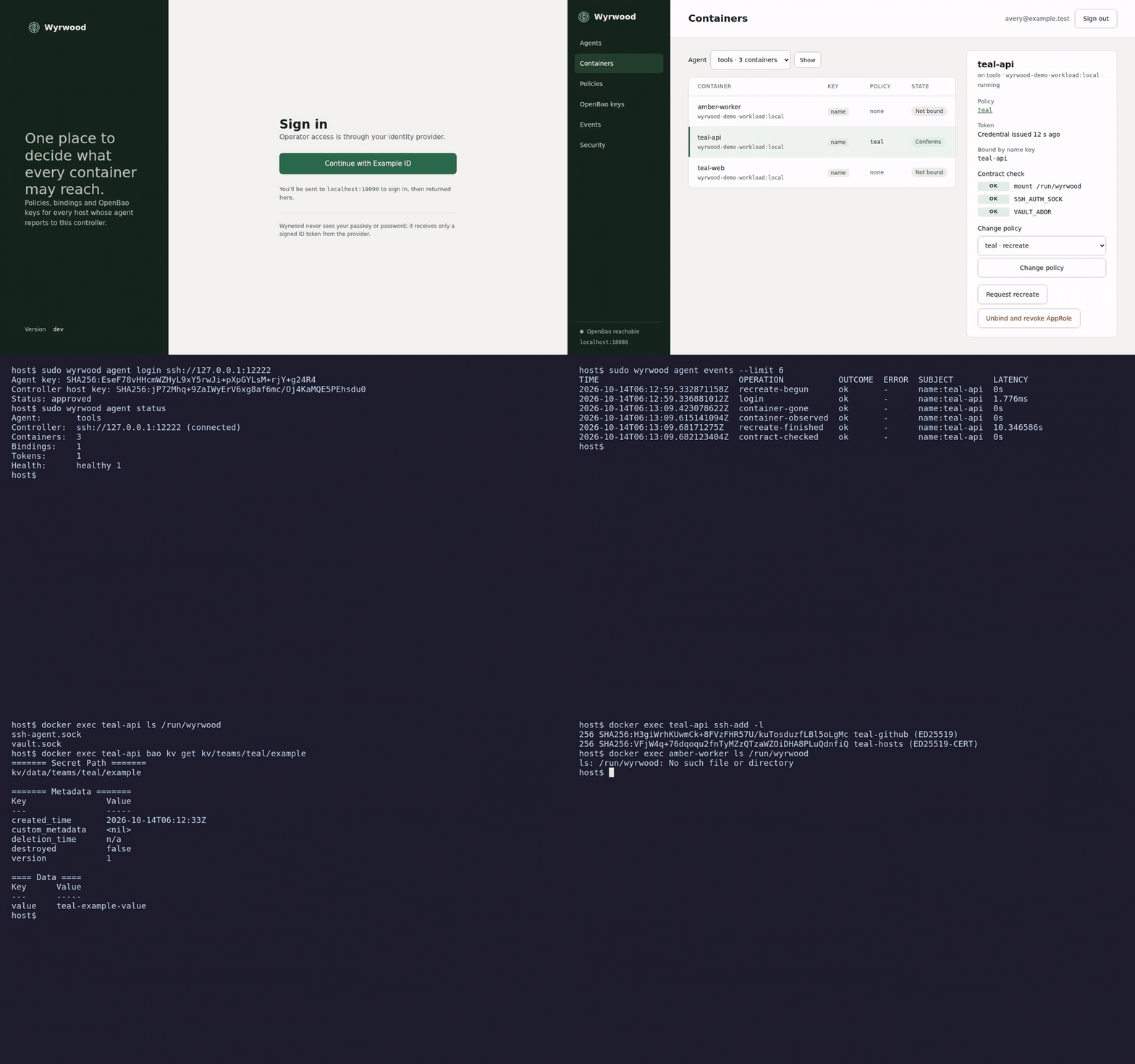
Wyrwood has two parts:
- The controller runs once per site as a container. It owns policy, serves a web interface, and holds the only OpenBao credential that can write policies and AppRoles.
- The agent runs on each Linux host with Docker Engine. It enrolls with the controller over SSH, reports every container, and publishes each bound container’s sockets. The controller can also run this agent in its own process on a Linux host; see Controller with a local agent.
A policy pairs an OpenBao policy with a container contract. The OpenBao policy names the secrets a container may read and the keys it may sign with. The contract names the mount, environment values, and access group the container must have, and whether the agent only reports a container that lacks them or recreates it once at binding time.
A binding attaches a policy to a container by the most stable identity the engine offers: devcontainer labels first, then compose labels, then the container name. The controller creates one OpenBao AppRole per binding and hands the agent a role and a wrapped secret. The agent logs in, keeps the token in memory, and renews it when a selected policy enables agent token renewal.
Inside the container, the mounted directory holds two sockets:
vault.sockspeaks the OpenBao API. The agent replaces whatever credential the client sends with the container’s own token. A tool that insists on logging in first receives a placeholder and proceeds.ssh-agent.sockis a standard SSH agent. Its identities are OpenBao Transit keys and OpenBao SSH-engine certificates named by the policy. Every signature is produced by OpenBao.
Mounting the directory rather than a socket file keeps a replaced socket visible inside a running container. Removing a key or path from the policy takes effect on the next request without a restart.
Wyrwood retains only bounded, categorical operational events. They contain no tokens, secret values, signatures, payloads, paths, or raw upstream errors.
The agent supports Linux hosts with Docker Engine. The controller runs anywhere a container can reach OpenBao and accept SSH connections from agents.